85%
Professional experience
Cognifyz Technologies — Data Science Internship
This internship emphasized disciplined evaluation. The work involved building models, stress-testing their specifications and improving reliability through iteration rather than stopping at first-pass performance.
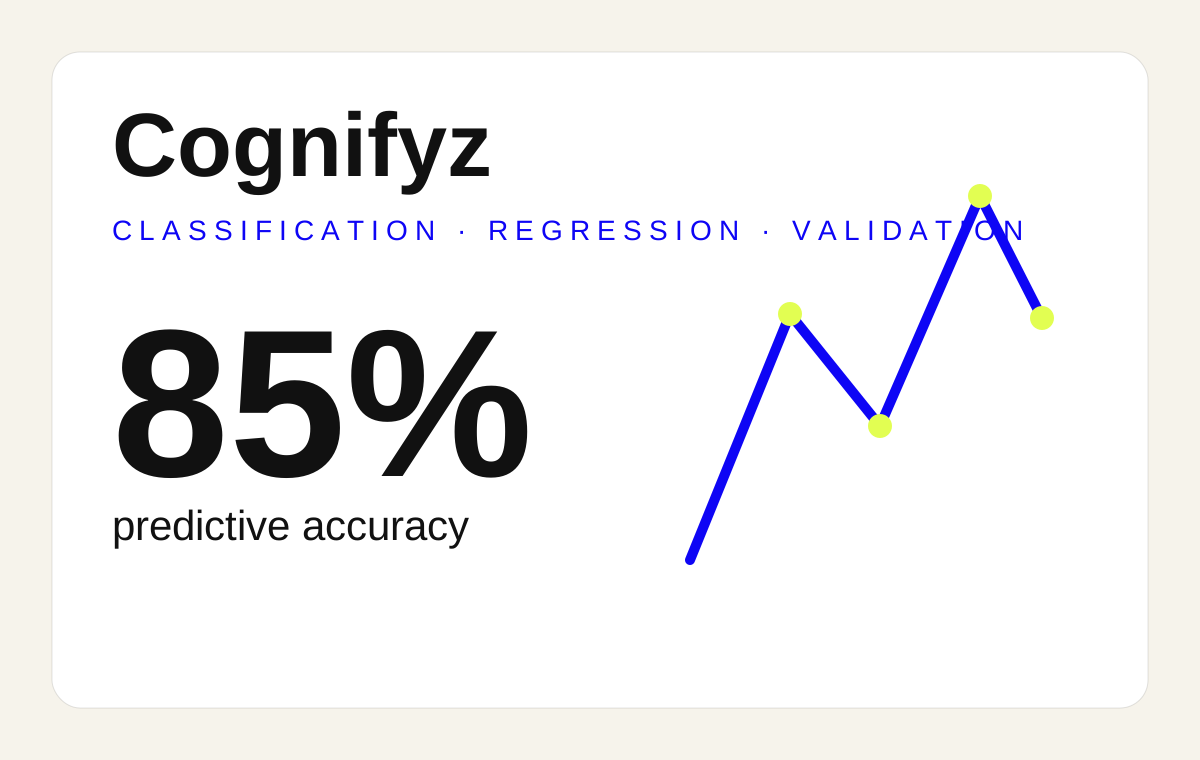
85%
18%
2+
Overview
Model development, validation and comparative benchmarking for classification and regression workflows.
The goal was to produce models that were not only accurate, but conceptually sound and reviewable. That meant evaluating the underlying specifications, performance trade-offs and limitations in a structured way.
01
Developed end-to-end workflows for both classification and regression tasks.
02
Used standard evaluation metrics, including AUC-ROC, F1-score and RMSE, to compare alternatives across problem types.
03
Iteratively tuned hyperparameters and assessed how changes affected both accuracy and reliability.
04
Documented limitations so the output could be consumed responsibly by stakeholders.
01
Reached 85% predictive accuracy on modeled tasks.
02
Improved prediction reliability by 18% through systematic iteration.
03
Demonstrated a strong validation mindset early in professional work.
Detailed notes
What the work demonstrates.
From training to validation
The internship covered the full loop: model design, implementation, metric selection, baseline comparison and documentation of model behavior.
Metric discipline
Rather than depending on a single performance view, the workflow combined multiple metrics that better reflected how different models performed in practice.
Stakeholder readiness
Limitations and model assumptions were documented so outputs were easier to review, explain and trust.
Career signal
This project is a strong indicator of readiness for analyst and data science roles where implementation quality and validation discipline both matter.